Partner Frona Brooks, Alice P. Smyth
Queer Places:
Smith College (Seven Sisters), 9 Elm St, Northampton, MA 01063
1212 Gilpin Ave, Wilmington, DE 19806, USA
Wilmington and Brandywine Cemetery, 701 Delaware Ave, Wilmington, DE 19801, United States
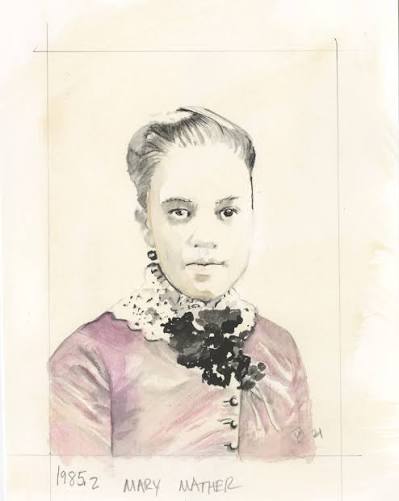 Mary H. Askew Mather (December 25, 1860 - May 8, 1925) was born on December 25, 1860, in Whitemarsh, Montgomery County, Pennsylvania, to Joseph M. Mather, an insurance
agent, and his second wife, Frances E. (Askew) Mather. She was the granddaughter of Dr. Henry F. Askew, a well-known physician in Delaware, which was her mother's home
state. After spending some years in Plainfield, New Jersey, her family relocated to Wilmington, Delaware, in 1881. Although her parents had married in a Friends (Quaker)
ceremony, Mary Mather became a member of the Westminster Presbyterian Church.
Mary H. Askew Mather (December 25, 1860 - May 8, 1925) was born on December 25, 1860, in Whitemarsh, Montgomery County, Pennsylvania, to Joseph M. Mather, an insurance
agent, and his second wife, Frances E. (Askew) Mather. She was the granddaughter of Dr. Henry F. Askew, a well-known physician in Delaware, which was her mother's home
state. After spending some years in Plainfield, New Jersey, her family relocated to Wilmington, Delaware, in 1881. Although her parents had married in a Friends (Quaker)
ceremony, Mary Mather became a member of the Westminster Presbyterian Church.
She attended Smith College, a private women's liberal arts institution in Northampton, Massachusetts, where she excelled academically, played tennis impressively, and
served as class president. Graduating in 1883 with a strong interest in English, Smith College also became the backdrop for formative experiences regarding her identity and
sexuality. She developed close relationships with female classmates, including a romance with fellow student Frona Brooks that she
documented in her personal journal. Remaining woman-identified for the rest of her adult life, Mather embraced her sexuality despite the era's widespread oppression toward
homosexuality.
Following her graduation, Mather returned to Wilmington to live with her parents until their respective passings in 1903 and 1904. Inheriting a substantial estate from
her father's insurance success and her mother's property holdings, she dedicated her financial resources and energy to civic, social, and educational reforms. Her extensive
organizational involvements included Associated Charities, the Woman's Christian Temperance Union (WCTU), the Young Women's Christian Association (YWCA) board of directors,
the Consumers' League of Delaware, the Florence Crittenton Home (Door of Hope), the Presbyterian Home Missionary Society, a citizens committee teaching English to
immigrants, and the Woman's Peace Party of Wilmington, where she served as vice-president. She was also a founder and the first president of the Delaware Association of
College Women, later the American Association of University Women (AAUW).
Her most prominent leadership role was with the Wilmington New Century Club, the premier white women's club in the state, where she served as president from 1896 to 1898
under its guiding motto, "not for ourselves alone." While the club avoided an official stance on woman suffrage, it housed a dedicated faction of suffragists with whom
Mather worked closely. A passionate advocate for the cause, Mather explained her motivation in an April 22, 1914 interview with the Wilmington Morning News: "I believe in
women's suffrage first because I am an American. I love my country and my country's flag. I pick up the greatest document in the land and I have no rights under it. I am an
alien in Pennsylvania, the state of my birth, where the Declaration of Independence was adopted." By 1909, she was an officer in the Delaware Equal Suffrage Association
(DESA), lobbying the state legislature for a women's college, pushing for a state constitutional amendment for women's votes in 1913, and joining a 1914 delegation to
persuade U.S. Senators to support a federal amendment. Embracing the movement's branding, she wrote the lyrics to the song "The Little Yellow Rose of Equal Suffrage," which
was set to music by E. Rose Reese Ort and copyrighted in 1916.
After 1914, Mather shifted much of her focus toward literacy, books, and libraries, chairing the New Century Club's Literature and Library Extension Committee. She
championed free, diverse literary collections, helping establish free traveling libraries for rural Delaware residents and children, Acorn Libraries in rural schools, the
Voyager's Library in the state prison, the Lantern Library, and providing Braille books to visually impaired soldiers during the Great War. Furthermore, she and her life
partner, Alice P. Smyth, campaigned heavily to fund a Women's College at the University of Delaware, which opened in 1914. Upon
its establishment, Mather and her partner donated a large book collection for a Browsing Room patterned after one at Smith College, funded the Mather-Smyth Scholarship for
incoming freshmen, and supported an art history instructor position for a year.
Throughout her adult life and reformist endeavors, Alice P. Smyth stood as her intimate partner, companion, and co-worker. Following her parents' deaths, Mather sold the
family home at 1021 Madison Street and purchased a large historic house named "Timberton" at 1212 Gilpin Avenue, where she and Smyth lived together for the remainder of
Mather's life. Locally known as "their home," the residence frequently hosted receptions and fundraisers for their shared causes. Historians categorize their relationship as
a "Boston marriage," though documentation remains ambiguous as to whether the bond was romantic and sexual or strictly platonic. Their public profile was defined by their
activist collaboration, alongside attending Mather's 40th college reunion in 1923, where Smyth was made an adoptive member of the class of 1883.
Mary H. Askew Mather died at the age of 64 on May 8, 1925, in Wilmington, and was buried alongside her parents at the Wilmington and Brandywine Cemetery. In her will, she
left bequests to the YWCA, the Florence Crittenton Mission, and the Browsing Room at the Women's College, while granting Alice Smyth half of a life interest in "Timberton"
alongside personal effects, including her four-stone diamond ring. Honoring her partner's legacy, Smyth dedicated the New Castle County Free Library system's rural book
service to Mather and funded a memorial rural book service in 1927. When Alice Smyth passed away in 1955, her final bequests included donating their home and $5,000 to the
YWCA, $1,000 to maintain the college Browsing Room, and $20,000 to the New Castle County Free Library fund to sustain the traveling book service in memory of Mary H. Askew
Mather. In recognition of their combined contributions to the university, Smyth Hall at the University of Delaware was subsequently named in honor of Alice P. Smyth.
References:
Other references:
- Mather, Mary H. Askew, Journals and Correspondence, 1882–1883 – Sophia Smith Collection, Smith College, Northampton, Massachusetts.
- Historical Society of Pennsylvania – Philadelphia, Pennsylvania (Collection Name: Historic Pennsylvania Church and Town Records; Reel: 802).
- New Castle County Register of Wills – Wilmington, Delaware (Frances Mather will, file #303; available via Ancestry.com).
- Wilmington Morning News – "Gives Reason For Wanting Suffrage - Miss Mary H. Askew Makes Interesting Address Before Current Events Class" (April 22, 1914).
- The Little Yellow Rose of Equal Suffrage – Lyrics by Mary H. Askew Mather, music by E. Rose Reese Ort (Copyrighted in 1916; inscribed copy preserved at the Delaware Historical Society).
- Biographical Sketch of Mary H. Askew Mather – Alexander Street Documents / Women and Social Movements in the United States.
- Baumgartner, Barbara Walker – "The New Castle County Free Library 1927–1933" (Excerpt from Delaware History, Vol. 22, 1986, pp. 46–56).
- The Delaware Women's Hall of Fame – Profile and biographical compilation for Mary Askew Mather (Inducted 1985).
- University of Delaware University Archives and Records Management – Historical accounts regarding the founding of the Women's College, the Mather-Smyth collection, and campus landmarks (The University of Delaware: A History, Chapter 7).
- Delaware Public Archives – Historical marker documentation and records concerning the Wilmington New Century Club.
Support this project
This website is a passion project researched, developed, and funded entirely by me. If you find the content valuable and would like to help support the ongoing research and hosting costs, any contribution is deeply appreciated.
Thank you for keeping this independent resource alive!
My books on Amazon: Elisa Rolle's books
BACK TO HOME PAGE
